
Why Trampoline Classes Activate More Muscles Than Floor HIIT
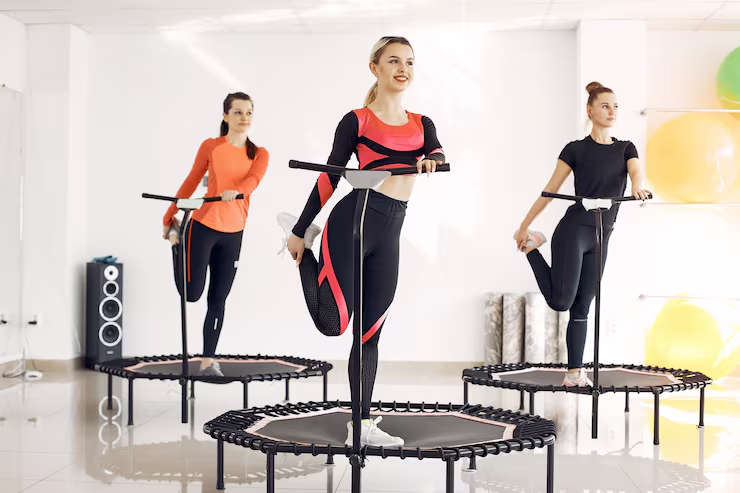
When most people think of high-intensity interval training, they picture burpees, mountain climbers, and jump squats on a studio floor. These movements are effective, but they operate within a fixed gravitational plane. Bounce-based training introduces an entirely different stimulus by removing the stable surface beneath you and replacing it with a responsive, dynamic platform. Signing up for a trampoline class singapore does not just add variety to your routine; it fundamentally changes how your neuromuscular system has to work to keep you upright, balanced, and moving with control.
The Unstable Surface Advantage
Floor-based HIIT takes place on a surface that does not move. Your body learns quickly that the ground will behave predictably, so the stabilising muscles around your ankles, knees, hips, and spine gradually reduce their contribution during repeated sessions. This is not a flaw in floor HIIT; it is simply how the nervous system adapts to reduce energy expenditure.
A trampoline mat is never fully predictable. Each landing is slightly different depending on where your foot contacts the surface, how much force you applied, and how the mat recoils. This variability keeps the stabilising muscles engaged throughout the entire session because they cannot switch into a reduced-effort mode.
The key muscle groups that stay constantly active during bounce training include:
- The tibialis anterior and peroneals for ankle stabilisation
- The gluteus medius for lateral hip control
- The deep spinal erectors and multifidus for postural maintenance
- The transverse abdominis for intra-abdominal pressure regulation
Core Engagement: A Fundamental Difference
In floor HIIT, core engagement is often cued by the instructor and depends on the individual’s awareness and habit. It is possible to get through many floor exercises with minimal deep core activation, particularly if the superficial muscles compensate.
On a trampoline, the core cannot opt out. Every landing requires the deep stabilisers to fire in order to prevent the pelvis from tipping and the spine from collapsing under the sudden load. This is an involuntary, reflexive contraction that happens below conscious awareness.
Over time, this consistent, reflexive core activation builds functional stability that transfers directly to daily movement, sport performance, and injury prevention. It is the kind of core training that planks and crunches are trying to replicate but rarely achieve in the same integrated way.
Upper Body Activation During Bounce Training
Floor HIIT can target the upper body through push-ups, tricep dips, or medicine ball work. However, these are generally isolated upper body exercises added into a circuit. The upper body is largely a passenger during the cardio portions of a floor session.
During trampoline training, the arms are used continuously to assist balance, generate momentum, and control rotation. The shoulders, upper back, and arms work in coordination with the lower body throughout the session rather than in isolated bursts. This integrated upper body involvement increases total muscle recruitment and raises caloric expenditure beyond what floor cardio typically achieves at the same perceived effort level.
Glute and Hamstring Loading: What the Research Suggests
Electromyography studies comparing trampoline exercise to treadmill running and floor aerobics have consistently shown higher activation in the posterior chain during bounce-based movement. The glutes and hamstrings must work hard during each landing phase to absorb force, control knee tracking, and prepare for the next takeoff.
Floor HIIT exercises like squat jumps do engage the posterior chain, but the landing surface absorbs some of the eccentric load. On a trampoline, the mat’s recoil adds an additional reactive demand that keeps the hamstrings and glutes under tension for longer during each repetition.
This has practical implications for:
- Athletes looking to develop explosive lower body power
- Individuals targeting glute development without heavy barbell loading
- Older adults who need posterior chain strength without high joint stress
Proprioception and the Nervous System Load
Proprioception refers to the body’s ability to sense its position in space. It is the reason you can walk without looking at your feet. Proprioceptive training is a cornerstone of rehabilitation and athletic development because it reduces injury risk and improves movement efficiency.
Floor surfaces offer minimal proprioceptive challenge once you have adapted to them. A trampoline mat creates constant proprioceptive demand because the surface is always shifting slightly. Your ankles, in particular, are receiving and processing sensory information at a much higher rate than during any floor-based workout.
This neural load means your session is not just physically demanding; it is cognitively engaging in a way that accelerates neuromuscular adaptation and improves coordination over time.
Caloric Output and Muscle Fibre Recruitment
The greater the number of muscles involved in an activity, the higher the caloric output for the same duration. Trampoline class singapore workouts consistently show higher total muscle recruitment compared to equivalent-duration floor HIIT sessions, which translates directly into greater energy expenditure.
Furthermore, the reactive nature of bounce training recruits fast-twitch muscle fibres more consistently than steady-state floor exercises. Fast-twitch fibres are responsible for explosive power and also have a higher metabolic cost. Activating them throughout a session rather than only during peak effort moments increases the afterburn effect, meaning your body continues to burn calories at an elevated rate after the session ends.
Accessibility Without Sacrificing Intensity
One of the frequent criticisms of high-intensity training is that it excludes individuals with joint pain or movement limitations. Floor HIIT, despite modifications, still places direct impact on knees, ankles, and wrists through jumping and weight-bearing exercises.
Trampoline training absorbs the majority of landing impact through the mat’s elasticity, reducing joint stress significantly while maintaining the muscular and cardiovascular demand. This makes it one of the few training formats that can deliver genuine high-intensity muscle activation to individuals across a wide range of fitness levels and physical conditions.
TFX Singapore structures its bounce sessions to accommodate beginners and experienced athletes alike, ensuring the neuromuscular benefits are accessible regardless of your starting point.
FAQs
Q: Will trampoline classes help with muscle definition or just cardio fitness? A: Bounce training contributes to both. The high muscle recruitment across the posterior chain, core, and stabilisers creates a toning effect, while the cardiovascular demand supports fat loss. The combination produces visible definition changes over consistent training cycles.
Q: Is trampoline training suitable for someone returning from a lower body injury? A: It can be, but clearance from a physiotherapist is essential first. The reduced impact makes it a viable option during later stages of rehabilitation, but the proprioceptive demand means it should be introduced gradually and with proper supervision.
Q: How does trampoline training compare to reformer Pilates for muscle activation? A: Both target stabilising muscles effectively, but through different mechanisms. Reformer Pilates uses spring resistance in a controlled range of motion, while trampolining uses reactive, gravity-driven force across a full range of dynamic movement. Many athletes benefit from incorporating both into their training cycle.
Q: Can I build meaningful leg strength through trampoline classes alone? A: Trampoline training builds functional leg strength and endurance effectively, particularly in the glutes, hamstrings, and calves. For maximum hypertrophy or raw strength gains, it works best when paired with resistance training rather than as a standalone strength programme.